

Battery payback check
Will a battery pay for itself in your home?
It takes about three minutes. We use current plans from Energy Made Easy, and we'll tell you if a battery isn't worth it yet.
Your bill
Start with your bill
Have smart meter data? Add it for an even closer answer
Ask your retailer for your "interval data" or "NEM12 file". Many let you download it from your online account. A full year is best. The file is read here in your browser and never uploaded.
Your typical bill
What you usually pay, after any solar credits.
Your plan
Single rate: one price all day. Time of use: different prices at different times.
No bill handy? Pop in a rough figure instead, then carry on.
Your home
Your home
Our best guess for each is marked our guess. Tap anything that's different for your home.
Solar panels
Adding solar with the battery?Upgrading your solar at the same time?
The federal battery discount needs the battery connected to solar.
How much new solar?
Most homes suit 6.6 kW. Choose more if you use a lot of power or plan an electric car.
Replace your current panels?
Systems under 5 kW are usually old enough to replace.
Home during the dayOn weekdays, is someone usually home?
Cooling
Heating
Hot waterOff-peak electric runs on its own cheaper line on your bill (often Tariff 31 or 33).
Planning to add?
New appliancesTap any that apply.
When does the car charge?
Installation
These mostly change the price. Leave anything you're not sure of and we'll show a range.
Backup in a blackoutEssentials means a few circuits, like the fridge, lights and wifi. Backup needs extra wiring.
SwitchboardModern boards have switches. Old ones have fuses and usually need upgrading first.
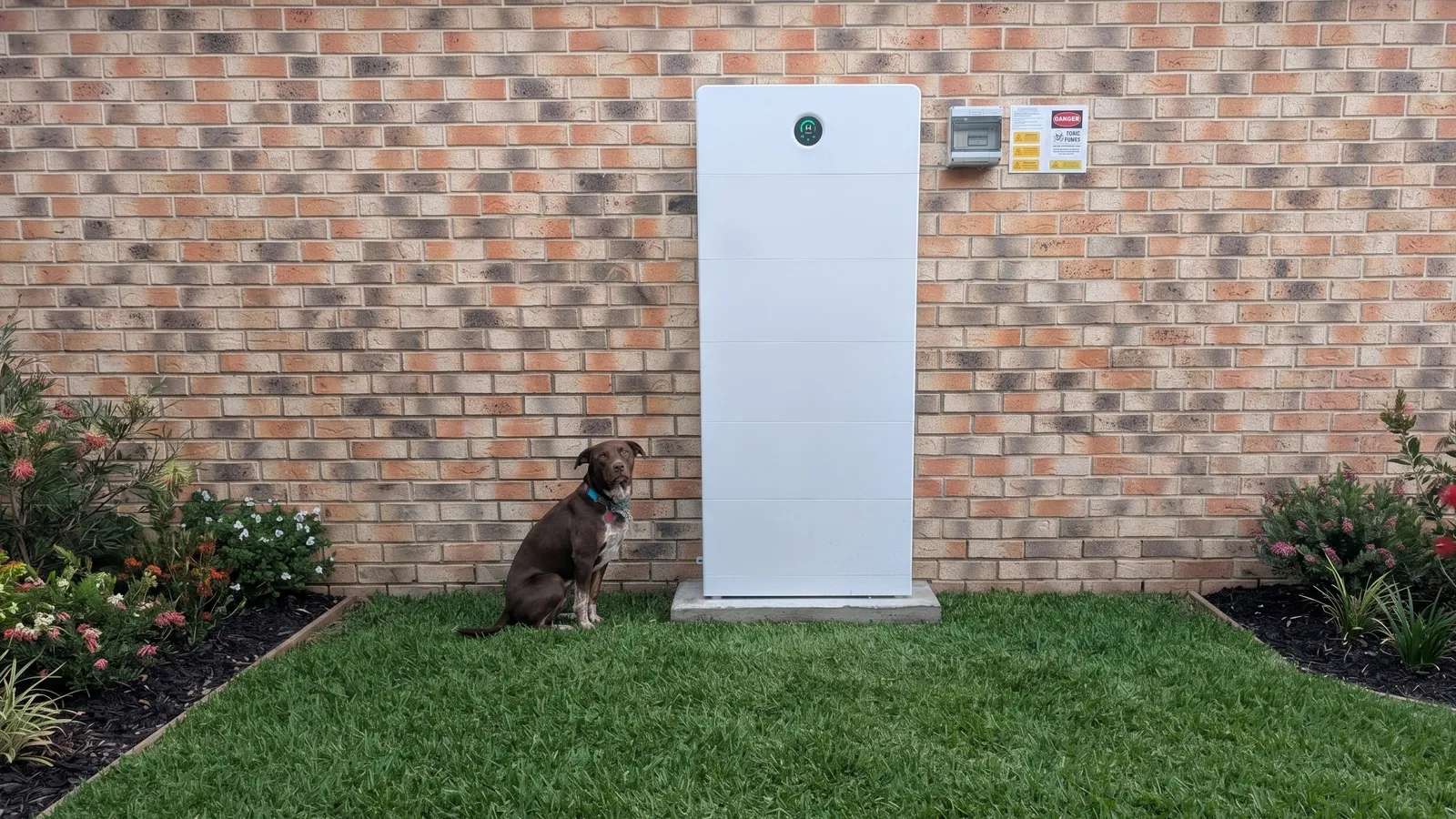
Where the battery would goOutside means an outside wall or carport.
Where can a battery go?
Too close to a door or window Fine
Usually fine
- A garage wall. If a car could hit it, we add a bollard.
- An outside wall or carport, ideally out of the afternoon sun.
- Near your switchboard, which keeps cabling short and the price down.
Not allowed
- Inside living areas: bedrooms, living rooms, kitchens, studies.
- In the roof or ceiling space, inside walls, or under stairs.
- In a hallway, or anywhere you'd need to get out in an emergency.
- Within 60 cm of a door, of a window or vent into a living area, or of an appliance like a hot water system or air-conditioner, or within 90 cm below one. A wide garage door can be closer if a 1 m walkway stays clear.
If the wall backs onto a bedroom or living area, we fit a fire-resistant sheet behind the battery. We check the spot against the battery standard (AS/NZS 5139) on site.
Distance to the switchboard
How to measure
- Your switchboard is usually in the meter box on an outside wall, or in a cupboard in the garage, laundry or hallway.
- Measure the way a cable would run: along walls, through the ceiling or under the floor, not straight through rooms. One big step is about a metre.
- If the cable would go up into the ceiling and down again, add about 5 m.
Power supplyMost homes are single phase. Not sure? Leave it.
Based on
The full breakdown
Next step
Send this estimate to Give.
We'll check the size, switchboard and install on site. It's an estimate, not a quote. We only send the summary, never your bill.
Prefer to talk? Call (07) 3180 8812.